
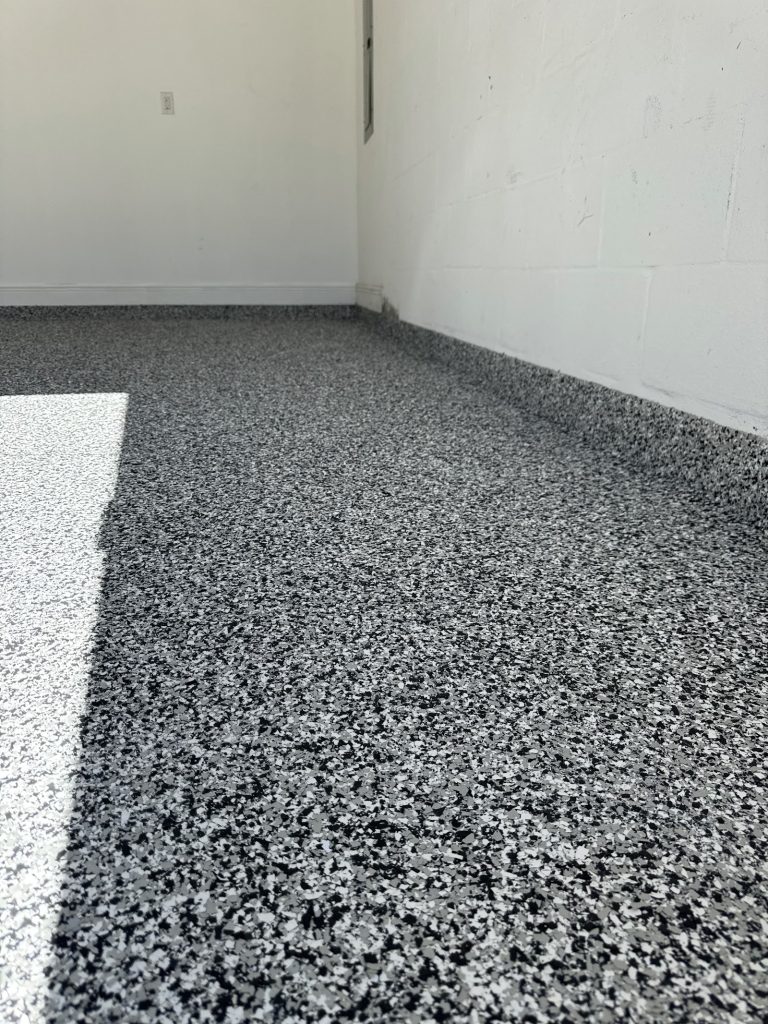
For most homes, the best flooring for Florida garages is a professionally installed resin coating (a thick epoxy base with a polyaspartic topcoat, or a full polyaspartic system) applied over a diamond-ground slab. It handles heat, humidity, hot tires and spills better than garage paint, and it doesn’t trap water the way interlocking tiles can. A clear concrete sealer is the budget option that protects the slab without changing its look, and it can make sense for some garages.
Below is a plain-spoken comparison of the four main garage floor options homeowners in Tampa Bay, Ruskin and Sarasota ask us about, including where each one fits and where it doesn’t.
What Makes Florida Garages Different
A garage floor in Ohio and a garage floor in Apollo Beach face very different conditions. Before comparing options, it helps to know what a Florida garage floor has to survive:
- Heat: tires come off hot asphalt and sit on the floor, softening weak coatings.
- Humidity: summer dew points in the 70s°F mean condensation on cool slabs, and coatings can only go down when the slab is at least 5°F above the dew point.
- Slab moisture: most homes are slab-on-grade, coastal areas have a high water table, and older slabs often have a missing or damaged vapor barrier.
- Storms and flooding: afternoon downpours, wet cars, and occasional storm-surge or flood cleanup.
- Sun: the front of the floor gets direct UV every time the door is open.
Any flooring choice has to deal with all five. For more on moisture specifically, see our article on moisture problems in Florida concrete.
Garage Floor Options Compared
| Option | Durability in Florida | Hot-tire resistance | Moisture tolerance | Relative cost |
|---|---|---|---|---|
| Professional resin coating (epoxy / polyaspartic) | Excellent; 15–20+ years with proper prep | Excellent when thick and on a ground slab | Good; moisture primer available if testing warrants | Higher upfront |
| Interlocking tiles | Good for the tiles themselves | Good | Fair; water and debris can collect underneath | Moderate to high |
| Garage floor paint / DIY kits | Poor; often peels within a year or two | Poor | Poor | Lowest |
| Clear concrete sealer | Fair; reapplied periodically | Not a film, so nothing to lift | Good; breathable penetrating types tolerate moisture | Low |
Option 1: Professional Resin Coatings
A professional coating is a multi-layer system bonded directly to the concrete. It typically starts with diamond grinding to open the slab, followed by crack and pit repair, a thick base coat, optional decorative flake or metallic pigments, and a clear topcoat.
Why it works in Florida
- Bonded to the slab: there is no gap for water, dirt or pests to collect.
- Chemical resistance: standard epoxy resists oil, gas and antifreeze, so a drip wipes up instead of soaking in.
- UV-stable topcoats: aliphatic polyaspartic topcoats resist the yellowing that plain epoxy shows in sunlight.
- Easy cleanup: sealed floors rinse off after storms or flooding far more easily than bare concrete.
- Slip resistance: flake floors have natural texture, and anti-slip additives can go in the topcoat.
Downsides
It costs more upfront. Tampa-area pricing from HomeBlue puts a two-car garage at roughly $2,300–$3,600, and the garage is out of service for a short time: most residential jobs take 1–2 days, plus cure time before you park. Quality also depends heavily on the installer, because poor prep causes most failures. For garage-specific pricing, see our garage floor coating cost guide.
Within this category there are several looks and systems, including flake, metallic, solid color and quartz. We compare them in our guide to the best garage floor coatings for Florida homes, and the topcoat choice is explained in epoxy vs. polyaspartic.
Option 2: Interlocking Garage Floor Tiles
Interlocking tiles are rigid or flexible plastic squares that snap together and float on top of the slab. They have real advantages: they can go over cracked or stained concrete without grinding, individual tiles can be replaced, and they can be installed in a weekend.
The Florida problem with tiles
Because tiles float rather than bond, there is a gap between the tile and the concrete. In a humid climate that gap can hold moisture from wet cars, rain blown in under the door, or vapor coming up through the slab. Sand, dirt and spilled fluids can work through the seams and collect underneath where you can’t see or clean them. After a flood, tiles generally have to be pulled up to clean and dry the slab below.
Tiles can make sense for a rental where you don’t want to modify the slab, or as a temporary fix over a slab with serious moisture issues you aren’t ready to address. For a long-term floor in a Florida home, a bonded coating is usually the better choice.
Option 3: Garage Floor Paint and DIY Epoxy Kits
Garage floor paint and one-part or water-based “epoxy” kits from the hardware store are the cheapest way to change the color of your floor. Unfortunately they are also the most likely to fail in Florida.
- Too thin: hot tires soften thin films and pull them off, a failure called hot-tire pickup.
- Poor prep: kits usually rely on acid etching or a simple cleaning, which leaves an inconsistent surface profile and doesn’t remove old sealers.
- Weak chemical resistance: gas, oil and brake fluid can soften or stain them.
- Humidity: applying in summer conditions without checking dew point often leads to poor adhesion.
When paint fails, it usually fails in the tire paths first, and the peeling film must be ground off before any real coating can go down. That adds cost to whatever you do next. Our article on hot-tire pickup explains why this happens.
Option 4: Clear Concrete Sealer
A penetrating concrete sealer soaks into the slab and reduces water and stain absorption without forming a thick film on top. The floor still looks like concrete.
When a sealer is the right call
- You want protection on a tight budget and don’t care about appearance.
- The slab has moisture issues and you want a breathable treatment.
- The space is a workshop or storage area where looks don’t matter.
Limitations
Sealers don’t hide stains or cracks, don’t add much abrasion resistance, and need to be reapplied periodically. Oil and chemicals can still stain the floor if left sitting. They also have a hidden cost if you later decide to coat: many sealers must be ground off first. For a deeper comparison, see epoxy flooring vs. concrete sealer.
Which Garage Flooring Should You Choose?
Here is how we’d summarize it for Florida homeowners:
- You want a floor that lasts and looks finished: professional resin coating on a ground slab.
- You rent or can’t modify the slab: interlocking tiles, with the understanding that you’ll need to lift them to clean underneath.
- You want basic protection for the lowest cost: clear penetrating sealer.
- You’re considering paint: in most Florida garages, the money is better saved toward a real coating or spent on a sealer.
Special cases
New construction: new slabs typically need about 28 days to cure before coating, and they should still be moisture-tested. Common in growing areas like Ruskin, Apollo Beach and Parrish.
Golf carts and workshops: in communities like Sun City Center, garages often double as golf cart parking or hobby space. Coatings handle the charging area and tool drops well, and flake texture helps with footing.
Coastal homes: near the Gulf, salt air and sand come in every time the door opens. A sealed, non-porous coating makes rinsing easy.
The Bottom Line
Every option has a place, but for a Florida home you plan to stay in, a professionally installed coating is the best flooring for Florida garages because it bonds to the slab, resists heat and chemicals, and cleans up easily. The key is prep: diamond grinding, crack repair and moisture awareness make the difference between a floor that lasts 15–20+ years and one that peels in two.
If you’re weighing options for your own garage, One of a Kind Epoxy offers free on-site estimates across Hillsborough, Manatee and Sarasota counties. Learn more about our garage floor coatings, or read our complete guide to epoxy flooring in Florida.
Frequently Asked Questions
Are garage floor tiles better than epoxy in Florida?
Tiles can go over damaged concrete without prep, but they float on the slab and can trap water and debris underneath in humid weather. A bonded coating is usually the better long-term choice for a Florida home.
Is garage floor paint worth it in Florida?
Usually not. Thin paints and DIY kits tend to peel from hot tires and humidity, and the failed coating has to be ground off before a better system can be applied.
What is the cheapest way to protect a garage floor?
A clear penetrating concrete sealer is the lowest-cost way to reduce stains and water absorption. It needs periodic reapplication and won't hide cracks or stains.
What garage floor holds up best to hot tires?
A thick 100%-solids epoxy base with a polyaspartic topcoat over a diamond-ground slab resists hot-tire pickup far better than thin paints or one-part kits.
Can I put a coating on a new garage slab?
Yes, but new concrete typically needs about 28 days to cure first, and it should be moisture-tested before any coating goes down.
Get a Free Estimate From One of a Kind Epoxy
One Of A Kind Epoxy Design And Painting has 15+ years of coating experience across Ruskin, Apollo Beach, Sun City Center, Riverview, Tampa, Parrish, Bradenton, Lakewood Ranch, Sarasota, Venice and North Port. Every floor starts with diamond grinding and crack and pit repair, then a coating system chosen for Florida heat, humidity and UV.
Call 941-281-8866 or request your free on-site estimate. We’ll measure your space, check the slab, and recommend the right system for how you use it.