
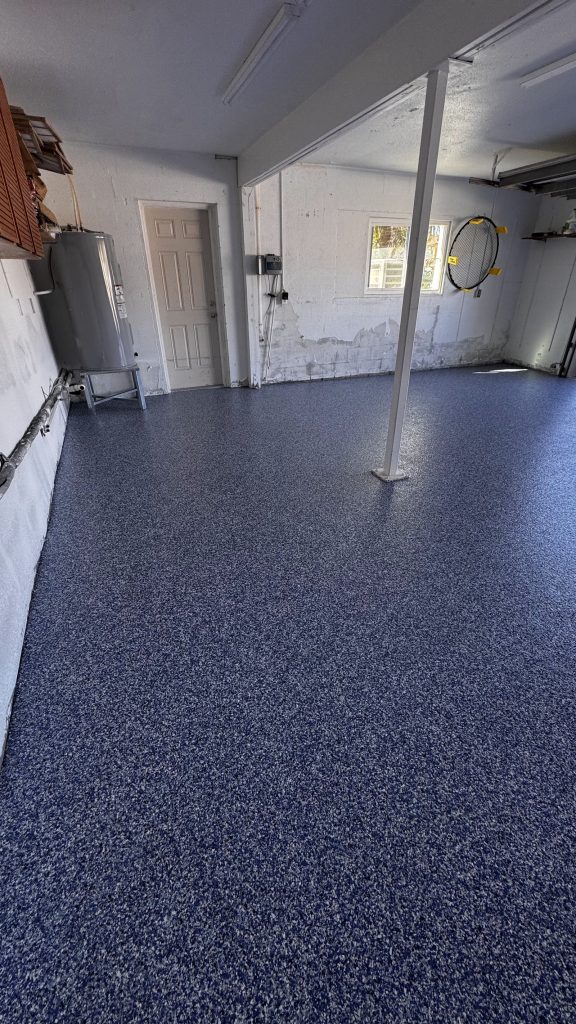
In the epoxy vs. polyaspartic debate, polyaspartic wins on UV stability and cure speed, while epoxy wins on build thickness, working time, and lower material cost. For most Florida garages, the best choice isn’t one or the other: a 100%-solids epoxy base coat with a polyaspartic topcoat combines the strengths of both. A full polyaspartic system is a great option too, especially when fast turnaround matters, but it costs more and demands a skilled crew in Florida heat.
Here is how the two compare, where each one makes sense, and what typical pricing looks like in Tampa Bay and Sarasota.
What Is the Difference Between Epoxy and Polyaspartic?
Epoxy is a two-part resin and hardener. A 100%-solids epoxy goes down thick, soaks into a properly ground slab, and cures into a hard, dense film. It is aromatic, which means it ambers (yellows) and chalks when exposed to UV light.
Polyaspartic is a type of aliphatic polyurea. Aliphatic chemistry is UV-stable, so it doesn’t yellow in sunlight. It cures much faster than epoxy and is typically used as a clear topcoat, or sometimes as a full system from base to top.
Epoxy vs. Polyaspartic: Side-by-Side
| Factor | Epoxy (100% solids) | Polyaspartic |
|---|---|---|
| UV stability | Ambers and chalks in sunlight | UV-stable; won’t yellow |
| Walk-on time | About 24 hours | Same day, often within hours |
| Vehicle traffic | About 72 hours | Typically 24–48 hours |
| Full chemical cure | About 7 days | Faster, depending on product |
| Working time in heat | Longer, more forgiving | Short; heat shortens it further |
| Build thickness | Builds thick in one coat | Usually applied thinner |
| Hot tire and stain resistance | Good when thick and well bonded | Excellent as a topcoat |
| Metallic designer floors | The standard choice | Not typically used for metallic effects |
| Material cost | Lower | Higher |
All cure times depend on the product and conditions, including slab temperature and humidity.
Where Polyaspartic Is Better
UV stability near the garage door
Florida sun is relentless. Any part of a garage floor that gets direct sunlight when the door is open, plus lanais and other outdoor concrete, will yellow if epoxy is the top layer. A polyaspartic topcoat stays clear and holds its color. For outdoor areas specifically, see can epoxy be used outdoors in Florida.
Fast return to service
Polyaspartic lets you walk on the floor the same day and typically drive on it in 24 to 48 hours. That is a big deal for homeowners who can’t leave cars in the driveway for most of a week, and for businesses that can’t close for long. Our post on how long a garage floor coating takes covers install and cure schedules in detail.
Hot tire and abrasion resistance
As a topcoat, polyaspartic is hard and resists hot tire staining and abrasion very well. That matters in Florida, where cars come home off hot pavement most of the year. We explain why cheap floors fail in hot tire pickup: why cheap garage coatings peel in Florida.
Where Epoxy Is Better
Building thickness and bonding to the slab
A 100%-solids epoxy base builds real thickness and wets into a diamond-ground surface, giving the system a strong foundation. It also carries a heavy flake broadcast well.
Working time in Florida heat
High heat shortens pot life and working time for any coating, and polyaspartic already starts short. On a hot Tampa Bay afternoon, a crew might have only minutes to spread a batch. Epoxy’s longer working time gives more margin for a smooth, even application. Neither product fixes bad timing: the slab still has to be at least 5°F above the dew point, and direct sun on the slab can cause outgassing bubbles.
Metallic floors and countertops
Metallic designer floors and epoxy countertops and bar tops rely on epoxy’s flow and working time to create their effects. A polyaspartic or other UV-stable clear coat can go over the top where sunlight is a concern.
Cost
Epoxy materials cost less than polyaspartic, which keeps epoxy-heavy systems more affordable.
The Hybrid System: Why Many Florida Pros Use Both
Most full-system garage floors we install combine the two:
- Diamond grinding and crack repair
- A 100%-solids epoxy base coat, often with a full flake broadcast
- A polyaspartic clear topcoat, with anti-slip additive if wanted
The epoxy handles bonding and build, and the polyaspartic handles UV, hot tires, and wear. With proper prep, residential epoxy and polyaspartic floors can last 15 to 20+ years. For more on what affects lifespan, see how long epoxy flooring lasts in Florida.
Epoxy vs. Polyaspartic Cost in Florida
These are typical market ranges; the final price depends on a site visit, slab condition, repairs, and the system you choose.
| System | Typical range (per sq ft) |
|---|---|
| Hybrid epoxy base + polyaspartic top, flake | $6–$8 |
| Full polyaspartic system | $6.50–$9.50 |
| Metallic epoxy designer floor | $8–$11 |
| Moisture mitigation add-on | About $1.25–$1.75 |
Those figures reflect 2026 contractor pricing in the Sarasota market. For Tampa, HomeBlue reported about $5–$7 per square foot including materials in 2025, or roughly $2,300–$3,600 for a 500-square-foot two-car garage. Overall, most full-system professional garage installs in Tampa Bay and Sarasota land around $5 to $9.50 per square foot. For a detailed local breakdown, read how much a garage floor coating costs in Sarasota.
Quick Decision Guide
If you are still on the fence, match your situation to the list below.
- Standard two- or three-car garage, door open often: hybrid system, epoxy base with a polyaspartic topcoat and flake.
- You need the garage back as fast as possible: a full polyaspartic system, or a hybrid scheduled around a fast-cure topcoat.
- Showroom look, indoor space: metallic epoxy, with a UV-stable clear coat if any sunlight reaches it.
- Lanai, pool deck, or other outdoor concrete: UV-stable systems only; epoxy should never be the exposed top layer outside.
- Workshop with solvents or brake fluid: focus on chemical resistance first, then pick the topcoat. See our guide to chemical and stain-resistant floor coatings for which systems handle what.
- Tight budget: an epoxy-based flake system with a polyaspartic topcoat still beats a thin DIY kit by a wide margin.
A Word on DIY Polyaspartic Kits
Some retail kits now advertise polyaspartic. The chemistry is only part of the story. A polyaspartic applied thin over an acid-etched slab will still fail, and its short working time makes lap marks and uneven gloss likely for a first-timer, especially in a hot Florida garage in July. Whatever you choose, the slab needs diamond grinding, crack and pit repair, and a moisture check first. The topcoat can only perform as well as the bond underneath it.
It’s also worth remembering that “epoxy vs. polyaspartic” is often a false choice in sales conversations. Ask any contractor exactly what goes down in each coat, how thick it is, and why. A clear answer tells you far more than a brand name or a catchy system label.
So, Is Polyaspartic Better for a Florida Garage?
As a topcoat, yes, almost always. It is UV-stable, fast-curing, and tough against hot tires. As a full system, it is a strong choice if you need the fastest turnaround and are comfortable with the higher price, provided the installer has experience working with it in heat.
For most homeowners in Ruskin, Sarasota, Lakewood Ranch, and across Tampa Bay, a hybrid gives the best balance of durability, appearance, and cost. Epoxy on its own still makes sense for metallic floors, countertops, and indoor areas away from sunlight, as long as it gets the right topcoat where UV is a factor.
We install epoxy, polyaspartic, flake, and metallic systems and recommend what fits your floor, not what fits a sales script. Learn more about our polyaspartic floor coatings, our garage floor coatings or our work in Sarasota, and for everything else about coatings in our climate, see our complete guide to epoxy flooring in Florida.
Frequently Asked Questions
Is polyaspartic worth the extra cost?
For a Florida garage, a polyaspartic topcoat is usually worth it because it resists UV yellowing and hot tire staining and cures fast. A full polyaspartic system costs more and is mainly worth it when fast turnaround is a priority.
Does polyaspartic yellow in the sun?
No. Polyaspartic is an aliphatic coating, so it is UV-stable and holds its color in sunlight. Epoxy is aromatic and will amber and chalk if left exposed to UV without a UV-stable topcoat.
Can you drive on polyaspartic the same day?
You can usually walk on polyaspartic the same day, but vehicles typically need to wait 24 to 48 hours depending on the product and conditions.
Can polyaspartic be applied over epoxy?
Yes. A polyaspartic topcoat over a 100%-solids epoxy base is one of the most common garage floor systems in Florida, combining epoxy's build and bond with polyaspartic's UV and wear resistance.
Is polyaspartic harder to install than epoxy?
It has a much shorter working time, and Florida heat shortens it further, so it takes an experienced crew to apply it smoothly. That is one reason DIY polyaspartic results are often uneven.
Get a Free Estimate From One of a Kind Epoxy
One Of A Kind Epoxy Design And Painting has 15+ years of coating experience across Ruskin, Apollo Beach, Sun City Center, Riverview, Tampa, Parrish, Bradenton, Lakewood Ranch, Sarasota, Venice and North Port. Every floor starts with diamond grinding and crack and pit repair, then a coating system chosen for Florida heat, humidity and UV.
Call 941-281-8866 or request your free on-site estimate. We’ll measure your space, check the slab, and recommend the right system for how you use it.