
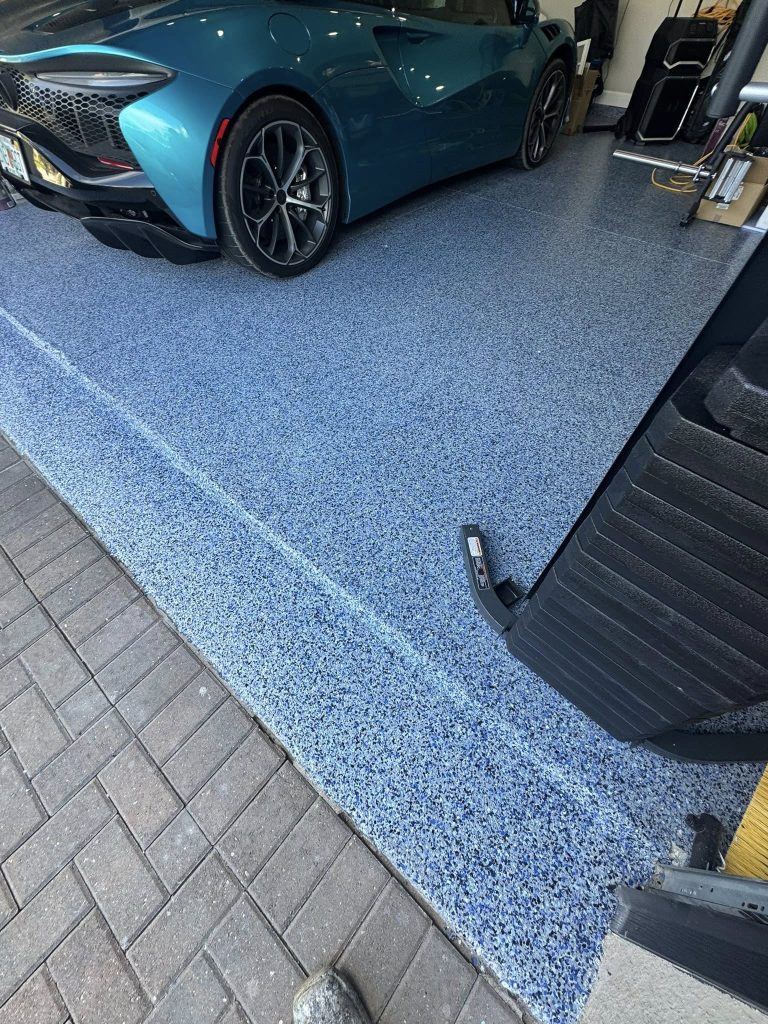
Hot tire pickup is when warm tires soften a garage floor coating, grip it, and tear it off the concrete when you pull the car out. It shows up as peeled patches in the exact spots where your tires sit. In Florida, it is one of the most common ways cheap coatings fail, and it almost always traces back to two things: a thin, low-solids product and a slab that was never properly prepared.
The good news is that hot tire pickup is preventable. A thick, 100%-solids epoxy base coat with a polyaspartic topcoat, installed on a diamond-ground slab, is built to handle Florida heat and tires. Below we explain what is actually happening under your car, why Tampa Bay garages are so hard on coatings, and how to tell whether a floor will hold up before you pay for it.
What Hot Tire Pickup Looks Like
Most homeowners notice it the same way: they back out of the garage one afternoon and see a tire-shaped patch of bare gray concrete, or flakes of coating stuck to the tread. Once it starts, it spreads. Each time you park, the edges of the damaged area give the tire another place to grab.
Common signs include:
- Peeled patches in the tire lanes, usually in a pattern matching the tread.
- Lifting or bubbling edges around those patches, where the coating has lost its bond but hasn’t torn off yet.
- Dark tire stains that won’t scrub out, often an early warning sign (more on that below).
- Coating that feels soft or tacky on a hot day, which means it is too thin or was never fully cured.
Why Hot Tires Pull Coatings Off the Slab
Two things happen at once when you park a car that has just been driven.
1. Heat softens thin coatings
Tires heat up from friction and from rolling over sun-baked asphalt. A hot tire sitting on a thin film transfers that heat directly into the coating. Thin, one-part and water-based products soften as they warm up. The rubber presses into the softened film, and as the tire cools it grips the coating tightly. When you drive away, the tire pulls harder on the coating than the coating is holding onto the concrete, and a piece comes off.
2. Plasticizers migrate out of the tire
Tires contain plasticizers, chemicals that keep rubber flexible. Heat drives those plasticizers out of the tire and into whatever the tire is sitting on. In a weak coating, they cause staining first. Over time they can soften the film and help break its bond with the slab, which leads to delamination. That is why brown or yellowish tire stains are often the first step toward a peel.
The real weak point: adhesion
Hot tire pickup is really an adhesion test. A coating that is mechanically locked into a properly opened concrete surface resists the pull. A coating sitting on top of a smooth, dusty, or sealed slab doesn’t. This is why prep matters as much as the product itself.
Why Florida Garages Are Especially Hard on Coatings
The same cheap kit that lasts a while in a cooler climate often fails fast here. A few local conditions stack up against it:
- Heat. Cars come home off hot pavement for most of the year, and garages in Ruskin, Riverview, and Sarasota stay warm well into the evening.
- Humidity and dew point. Summer dew points in the 70s°F make it easy to coat a slab that is too close to condensation, which weakens the bond from day one. We cover that in how Florida heat and humidity affect epoxy flooring.
- Moisture in the slab. Most homes here are slab-on-grade, many near the coast sit over a high water table, and older slabs often have missing or damaged vapor barriers. Moisture pushing up from below attacks the bond from underneath, so the tire has less to fight. See moisture problems in Florida concrete for how we test and treat it.
- Extra wheels. In communities like Sun City Center, a lot of garages hold a golf cart as well as a car, which means more tires and more parking spots to wear.
The Main Causes: Thin Products and Poor Prep
When we look at a peeling garage floor, the story is usually the same. Here is how a typical big-box kit compares with a professional multi-coat system.
| Factor | Typical DIY kit | Professional system |
|---|---|---|
| Product type | 1-part or water-based epoxy “paint” | 100%-solids epoxy base, polyaspartic topcoat |
| Film thickness | Thin; much of the product is water or solvent that evaporates | Thick build; what goes down stays down |
| Surface prep | Acid etch or cleaner | Diamond grinding to open the slab |
| Crack and pit repair | Usually skipped | Repaired before coating |
| Moisture check | Rarely done | Evaluated before choosing the system |
| Hot tire resistance | Poor; common failure in Florida | Designed to resist it |
Thin, low-solids coatings
Water-based and one-part products go on thin, and a large share of what is in the can evaporates as it dries. What’s left is a film too thin to resist heat and too weak to hold against a gripping tire. A 100%-solids epoxy doesn’t lose volume to evaporation, so the coating that goes down is the coating you keep.
Poor surface preparation
Concrete has a smooth, weak top layer, and many garage slabs also carry old sealers, oil, or curing compounds. If a coating is applied over that, it is only as strong as the weakest layer underneath. Diamond grinding removes that layer and opens the surface so the coating can lock in. We go deeper in proper concrete surface preparation for epoxy (grinding vs. acid etching).
Parking too soon
Even a good system can be damaged if a car is parked on it before it has cured enough. Cure times depend on the product and conditions: polyaspartic topcoats typically allow vehicles in about 24 to 48 hours, while epoxy-only systems often need around 72 hours. Our post on how long a garage floor coating takes walks through install, cure, and parking times.
What Actually Resists Hot Tire Pickup
A floor that stands up to Florida tires has a few things in common:
- A diamond-ground slab with cracks and pitting repaired first, so the coating has a clean, open surface to bond to.
- A thick 100%-solids epoxy base coat that soaks into that open surface and builds real thickness.
- A polyaspartic topcoat that is hard, heat-tolerant, and UV-stable, so it holds up to hot tires and doesn’t yellow near an open garage door.
- Enough cure time before the first car rolls in.
Flake broadcast into the base coat adds thickness and texture and helps hide tire marks and everyday dirt. If you are weighing epoxy against polyaspartic for the topcoat or the whole system, our comparison of epoxy vs. polyaspartic flooring in Florida covers the tradeoffs. For finish options such as flake, metallic, and solid color, see the best garage floor coatings for Florida homes.
Tire Stains vs. Tire Peeling
These get lumped together, but they are different problems.
- Tire staining is discoloration from plasticizers migrating into the surface. On a strong topcoat, it’s mostly cosmetic and often limited. On a weak coating, it’s a warning sign.
- Tire peeling is an adhesion failure. The coating is physically coming off the concrete.
A quality polyaspartic topcoat resists staining far better than a thin epoxy paint. Lighter solid colors will still show tire marks more than a flake blend, which is one reason flake floors are so popular in Tampa Bay garages.
Can You Fix a Floor That’s Already Peeling?
Not by putting another coat on top. A new coating applied over a failing one is only as strong as the old bond underneath, and it will peel right along with it. The honest fix is to remove the failed coating, grind the slab to a clean, open surface, repair damage, check for moisture, and install a proper system from the beginning.
That costs more than a weekend kit, which is why it pays to get it right the first time. Once a floor is installed correctly, residential epoxy and polyaspartic floors can last 15 to 20+ years with proper prep.
Simple Habits That Help Any Garage Floor
- Respect the cure time your installer gives you before parking.
- Sweep grit out of tire lanes regularly; sand under a tire acts like sandpaper.
- Wipe up oil and fluid drips promptly rather than letting them sit.
- Clean tire marks with a mild cleaner and soft brush, not harsh solvents.
- Use parking mats only if your installer approves them for your coating.
At One of a Kind Epoxy, we have spent 15+ years installing garage floor coatings across Hillsborough, Manatee, and Sarasota counties, and every system starts with diamond grinding and slab repair for exactly this reason. For the bigger picture on coatings in our climate, start with our complete guide to epoxy flooring in Florida.
Frequently Asked Questions
How do I stop my tires from peeling my garage floor coating?
Hot tire pickup is prevented by a thick 100%-solids epoxy base with a polyaspartic topcoat applied to a diamond-ground slab. Letting the floor cure fully before parking also matters. A thin DIY coating on an unprepared slab can't be made tire-proof by adding more coats.
Why is my new epoxy garage floor peeling where the tires are?
Usually the coating is too thin, the slab wasn't ground before coating, or the car was parked before the floor had cured. Moisture coming up through the slab can also weaken the bond and make peeling worse.
Does polyaspartic prevent hot tire pickup?
A polyaspartic topcoat is hard and heat-tolerant, so it resists hot tire pickup well when installed over a thick epoxy base on properly prepared concrete. No topcoat can make up for poor prep, though.
Can I recoat over a peeling garage floor?
No. A new coat over a failing one will peel along with it. The failed coating needs to be removed and the slab ground and repaired before a new system goes down.
Are tire marks on an epoxy floor the same as hot tire pickup?
Not exactly. Tire marks are staining from plasticizers in the rubber, while hot tire pickup is the coating actually tearing off the slab. Heavy staining on a thin coating is often an early warning sign of peeling.
Get a Free Estimate From One of a Kind Epoxy
One Of A Kind Epoxy Design And Painting has 15+ years of coating experience across Ruskin, Apollo Beach, Sun City Center, Riverview, Tampa, Parrish, Bradenton, Lakewood Ranch, Sarasota, Venice and North Port. Every floor starts with diamond grinding and crack and pit repair, then a coating system chosen for Florida heat, humidity and UV.
Call 941-281-8866 or request your free on-site estimate. We’ll measure your space, check the slab, and recommend the right system for how you use it.