
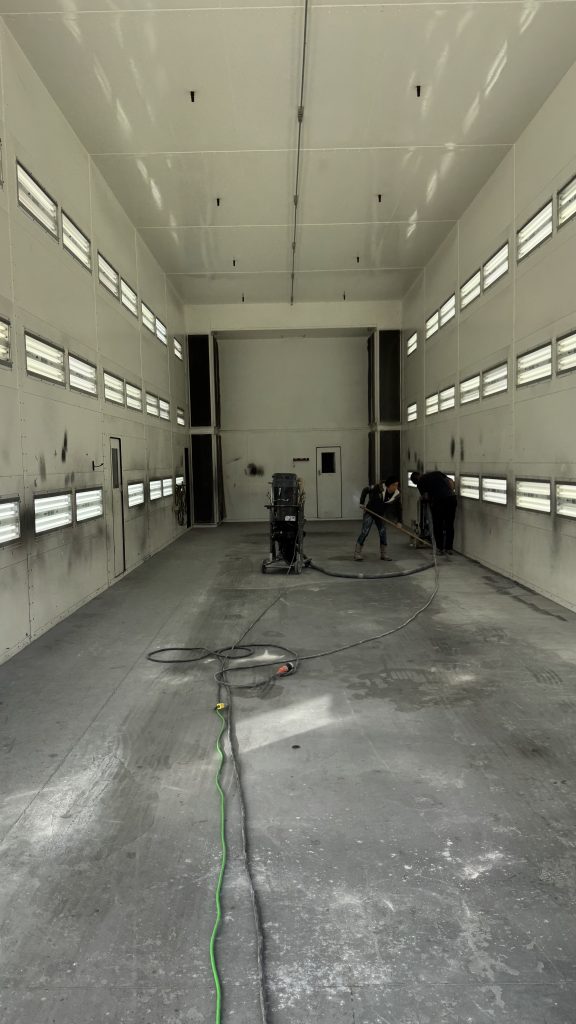
Proper concrete surface preparation for epoxy means diamond grinding the slab to open its pores, removing contaminants and old sealers, and repairing cracks and pitting before any coating goes down. Grinding is the better method in almost every case; acid etching gives an inconsistent surface, leaves residue, and doesn’t remove sealers. Prep is the single biggest factor in whether a floor lasts 15 to 20+ years or starts peeling in the first summer.
This post explains what prep actually involves, why we diamond grind instead of acid etching, and how to tell whether a contractor is doing it right.
Why Surface Preparation Matters So Much
Epoxy doesn’t stick to concrete like glue sticks to paper. It bonds best when it can flow into an open, textured surface and lock in mechanically. Freshly finished concrete has a smooth, weak top layer, and most garage slabs have picked up a few other things over the years:
- Curing compounds or sealers applied when the slab was poured
- Oil, grease, and tire residue
- Paint overspray, drywall mud, and adhesive
- Dust and laitance (the weak, powdery surface layer)
Coat over any of those and the coating is only as strong as that layer. When it lets go, the coating comes with it. Peeling, bubbling, and hot tire pickup almost always trace back to prep. We explain that last one in why cheap garage coatings peel from hot tires.
Concrete Surface Profile (CSP): What Epoxy Needs
The industry measures surface texture using the International Concrete Repair Institute (ICRI) Guideline 310.2R, which defines Concrete Surface Profiles from CSP 1 (nearly flat) to CSP 10 (very rough). Thin-film floor coatings typically need a CSP 2 to CSP 3, a surface that feels like medium sandpaper. Diamond grinding reliably produces that profile.
Too smooth, and the coating has nothing to grip. Too rough, and it takes a lot more material to cover the peaks, with a higher chance of pinholes. The goal is a consistent profile across the whole floor, not just in the spots that look dirty.
Diamond Grinding vs. Acid Etching
These are the two methods homeowners hear about most. Here is how they compare.
| Factor | Diamond grinding | Acid etching |
|---|---|---|
| Surface profile | Consistent CSP 2–3 across the slab | Inconsistent; varies with concrete and application |
| Removes sealers and curing compounds | Yes | No; acid can’t penetrate them |
| Removes weak surface layer | Yes | Partially at best |
| Residue | Dust, captured by vacuum | Salts and acid residue that must be neutralized and rinsed |
| Adds water to the slab | No | Yes, lots of rinsing |
| Levels minor high spots | Yes | No |
| Typical user | Professional installers | DIY kits |
Why acid etching falls short
Acid etching is popular in DIY kits because it is cheap and doesn’t need equipment. The problems:
- It doesn’t touch sealers. If your slab was sealed at any point, the acid just sits on top, and the coating bonds to the sealer instead of the concrete.
- It’s inconsistent. Harder areas etch less, softer areas more, and puddles etch more than thin spots.
- It leaves residue. Salts and leftover acid must be neutralized and thoroughly rinsed, and anything left behind weakens the bond.
- It puts water into the slab. In Florida, where slab moisture is already a leading cause of coating failure, soaking the floor right before coating is the opposite of what you want.
Why diamond grinding works
A diamond grinder uses rotating diamond-segmented heads to cut away the top layer of concrete. It removes laitance, old coatings, sealers, and contaminants, and it leaves a uniform, open profile. Modern grinders connect to industrial vacuums, so dust is captured as the work happens. It is the standard method we use on every floor at One of a Kind Epoxy.
The Full Prep Process, Step by Step
Grinding is the centerpiece, but proper concrete surface preparation for epoxy includes more than that.
- Inspect the slab. Look for cracks, spalling, pitting, old coatings, oil saturation, and signs of moisture.
- Evaluate moisture. Florida’s slab-on-grade homes and high coastal water table make this critical. Testing may include ASTM F1869 calcium chloride tests or ASTM F2170 in-slab humidity probes. We cover testing and mitigation in detail in moisture problems in Florida concrete.
- Degrease heavy oil spots so contamination isn’t spread by the grinder.
- Diamond grind the entire floor, with edge grinders along walls and in corners.
- Repair cracks and pitting with appropriate fillers, then grind repairs flush.
- Vacuum thoroughly so no dust is left in the pores.
- Check conditions before coating. The slab temperature should stay at least 5°F above the dew point during application and cure, and direct sun on the slab should be avoided to prevent outgassing bubbles.
Crack and Pitting Repair
Coatings aren’t a crack fix. A thin film will telegraph any crack or pit underneath it, and moving cracks can reflect through over time. Repairing them before coating gives a smoother, stronger floor. Pitting, which is common on older Tampa Bay slabs and on garages with salt exposure near the coast, gets filled so the coating has a continuous surface to lie on.
For a slab with years of wear, see can you put epoxy over old concrete for what is and isn’t fixable.
New Concrete Needs Time First
With so much new construction around Ruskin, Apollo Beach, and Parrish, we get this question often. New concrete typically needs about 28 days to cure before coating, and even then we verify moisture instead of going by the calendar. A new slab can still be releasing a lot of water, and coating it too soon traps that moisture under the film. New slabs also often have curing compounds on the surface, one more reason to grind.
Florida-Specific Prep Considerations
- Humidity and dew point. Summer dew points in the 70s°F mean a cool slab can collect condensation you can’t see. We check conditions, not just the forecast. See how Florida heat and humidity affect epoxy flooring.
- Afternoon storms. We plan work around them so rain and humidity spikes don’t hit freshly prepped or coated floors.
- Heat. Hot slabs shorten working time, so prep has to be finished and the floor ready before the coating is mixed.
Does Prep Change the Price?
Yes, and it should. Grinding, edge work, and repairs are labor, and a slab with heavy oil staining, an old coating, deep pitting, or high moisture takes more of it than a clean new floor. Moisture mitigation, when a slab needs it, is an added step on top of standard prep. That’s why an honest quote comes after someone actually looks at your concrete, not from a phone call.
It’s also why the cheapest quote isn’t always the cheapest floor. Skipping prep saves a few hundred dollars today and can cost the entire floor later, since a failed coating has to be ground off before anything new can go down. Prep is the one step you never see in the finished floor, and the one that decides how long it lasts.
How to Tell if a Contractor Preps Properly
Ask these questions before you sign:
- Do you diamond grind, or do you acid etch?
- How do you handle edges and corners?
- Do you repair cracks and pitting before coating?
- Do you check the slab for moisture?
- How do you control dust?
A contractor who wants to skip grinding to lower the price is skipping the step that decides how long your floor lasts. For more questions to ask, read how to choose an epoxy flooring contractor in Ruskin.
We offer concrete prep and polishing as a standalone service as well as part of every coating system. See our concrete polishing and pool deck coatings page or our garage floor coatings page. For how prep fits into the bigger picture, visit our complete guide to epoxy flooring in Florida.
The same diamond grinding equipment is used for concrete polishing, where the slab itself becomes the finished floor.
Frequently Asked Questions
Is acid etching good enough for epoxy?
Acid etching gives an inconsistent surface, leaves residue that must be neutralized, and won't remove sealers or curing compounds. Diamond grinding is more reliable and is the method most professional installers use.
What surface profile does epoxy need?
Thin-film floor coatings typically need a concrete surface profile of CSP 2 to CSP 3 under ICRI Guideline 310.2R. That feels similar to medium sandpaper and is usually achieved by diamond grinding.
Do I need to grind concrete before epoxy?
For a coating meant to last, yes. Grinding removes the weak surface layer, sealers, and contaminants and opens the concrete so epoxy can bond mechanically.
How long should new concrete cure before epoxy?
New concrete typically needs about 28 days to cure before coating. Moisture should still be tested, since a new slab can hold more water than the calendar suggests.
Does diamond grinding make a lot of dust?
Professional grinders connect to industrial vacuums that capture most of the dust as the work happens. Some fine dust is normal and is vacuumed up before coating.
Get a Free Estimate From One of a Kind Epoxy
One Of A Kind Epoxy Design And Painting has 15+ years of coating experience across Ruskin, Apollo Beach, Sun City Center, Riverview, Tampa, Parrish, Bradenton, Lakewood Ranch, Sarasota, Venice and North Port. Every floor starts with diamond grinding and crack and pit repair, then a coating system chosen for Florida heat, humidity and UV.
Call 941-281-8866 or request your free on-site estimate. We’ll measure your space, check the slab, and recommend the right system for how you use it.