
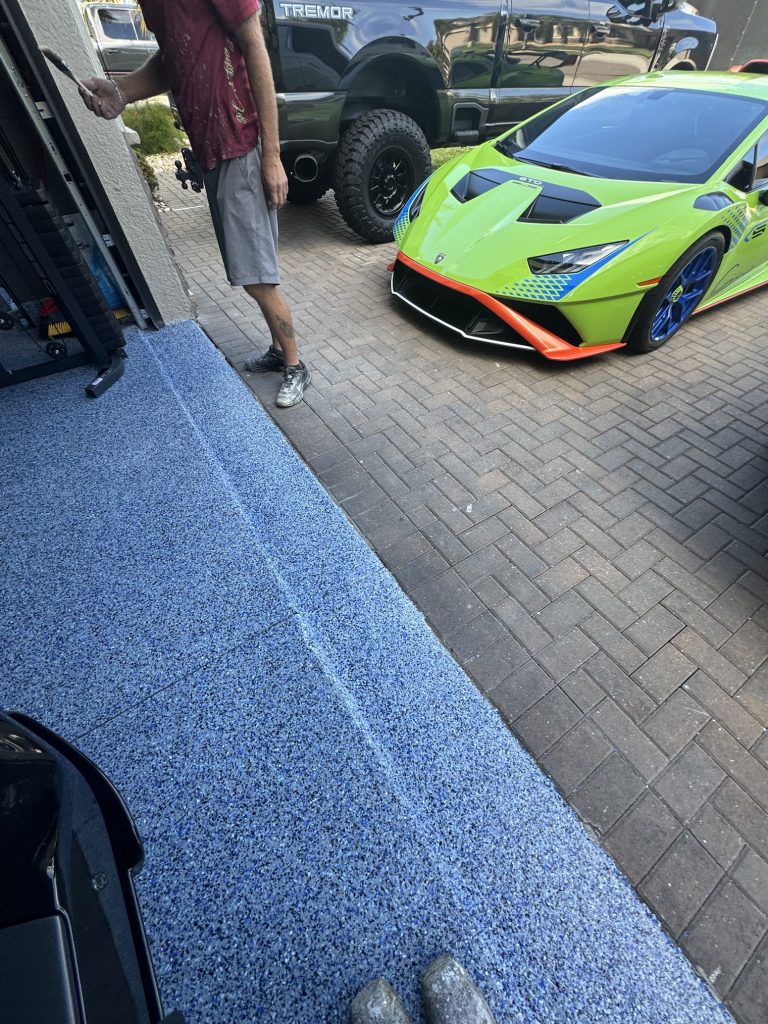
Epoxy flooring works very well in Florida, but only when the system and the prep are chosen for Florida conditions: slabs that hold moisture, summer dew points in the 70s, intense sun and hot tires. A properly ground slab with the right base coat and a UV-stable topcoat can last 15–20+ years in a residential garage. A thin coating rolled onto an unprepared slab often peels within a year or two.
This guide is the starting point for everything we have learned in more than 15 years of coating concrete across Hillsborough, Manatee and Sarasota counties. Each section gives you the short version and links to a detailed article when you want to go deeper.
Why Epoxy Flooring in Florida Is Different
Most coating failures we are called to fix in Florida trace back to the same few local conditions. Product labels are written for a national market. Tampa Bay and the Gulf Coast push those products harder than most places.
- Slab-on-grade homes over a high water table. Nearly every home here sits on a slab poured directly on the ground. In coastal Hillsborough, Manatee and Sarasota the water table is close to the surface, and older slabs often have a missing or damaged vapor barrier.
- Heat and humidity during installation. Summer dew points sit in the 70s°F, afternoon storms roll in almost daily, and a sun-baked slab can shorten working time dramatically.
- UV exposure. Garages with the door open, lanais and pool decks all get strong sun, and standard epoxy yellows and chalks under UV.
- Salt air and storms. Near the coast, salt air and occasional flood or storm-surge cleanup make a sealed, easy-to-clean floor valuable.
For the installation side of the climate question, read how Florida heat and humidity affect epoxy flooring. For the problem coming up from below, see our guide to moisture problems in Florida concrete and how to stop coating failure. And if the floor will see direct sun, start with whether epoxy can be used outdoors in Florida.
The Main Floor Coating Systems
“Epoxy floor” is used loosely to describe several different chemistries and finishes. Here is how the common options compare for Florida use.
| System | What it is | Florida strengths | Watch-outs |
|---|---|---|---|
| Epoxy (100% solids) | Thick, hard base coat that bonds strongly to ground concrete | Build, adhesion, resistance to oil, gas and antifreeze | Aromatic, so it ambers and chalks in UV; slower cure (vehicles ~72 hr) |
| Polyaspartic | Aliphatic coating used as a topcoat or full system | UV-stable, fast cure (vehicles typically 24–48 hr) | Short working time in heat; needs an experienced crew |
| Flake system | Base coat with broadcast vinyl flake, sealed with a clear topcoat | Hides dust and imperfections, natural texture for grip | Finish depends on topcoat quality |
| Metallic epoxy | Pigmented epoxy manipulated for a marbled, 3D look | Showroom look for garages, homes, retail | Needs a UV-stable topcoat where sun hits it |
| Urethane cement | Cement-based urethane flooring | Handles thermal shock from hot water, steam and hot oil | Different look and texture than epoxy |
| Penetrating sealer | Clear sealer that soaks into concrete | Low cost, breathable, fine for some outdoor slabs | No real build, color or protection from hot tires |
The biggest decision most homeowners face is base and topcoat chemistry. We compare them in detail in epoxy vs. polyaspartic flooring in Florida. If you are not sure you need a full coating at all, read epoxy flooring vs. concrete sealer. For finish choices, see the best garage floor coatings for Florida homes: flake, metallic, solid and quartz.
Garage Floors
Garages are the most common coating project in Florida, and the most common place we see cheap coatings fail. Florida garages hold heat, cars come in with hot tires after a drive on summer asphalt, and many garages double as workshops, laundry rooms or golf cart parking in communities like Sun City Center.
Why DIY and thin coatings peel
Hot tires soften thin coatings, and plasticizers migrate out of the tire rubber into the floor. The result is staining and patches of coating lifting right off the slab. The details are in hot-tire pickup: why cheap garage coatings peel in Florida.
Choosing the right floor
Coatings are not the only option. Interlocking tiles, garage paint and plain sealers all have fans. We lay out the trade-offs in best flooring for Florida garages: coatings vs. tiles vs. paint vs. sealer.
Downtime
Most residential garages are done in 1–2 days depending on size, repairs and the system chosen. Parking times depend on chemistry. See how long a garage floor coating takes, including cure and parking times.
Our garage floor coating service page covers the systems we install, with local pages for garage floor coating in Ruskin and garage floor coating in Sarasota, plus our polyaspartic floor coatings.
Pool Decks, Lanais and Outdoor Concrete
Lanais and pool cages are everywhere in Sarasota, Lakewood Ranch and Venice, and they take a beating from sun, rain and bare feet. Outdoor coatings need three things a garage floor may not: UV-stable topcoats, slip resistance and light colors that stay cooler to the touch.
Standard epoxy should not be the exposed layer outside. See UV protection for outdoor concrete for which chemistries hold up, and slip-resistant pool deck and lanai coatings for Florida homes for texture and color choices. Our concrete polishing and pool deck coatings page describes the service.
Commercial and Industrial Floors
Commercial floors carry heavier traffic, harsher chemicals and, in some cases, health code requirements. Two common Florida applications have their own guides:
- Commercial epoxy flooring for auto shops and garages, where brake fluid, solvents and battery acid call for tougher chemistry.
- Epoxy flooring for restaurants and commercial kitchens, where we often recommend urethane cement for cook lines and dish areas instead of standard epoxy.
Commercial floors are typically resealed periodically to keep them performing, which is worth budgeting for from the start.
Countertops and Bar Tops
Epoxy is not only for floors. Poured epoxy countertops and bar tops are popular for outdoor kitchens under a lanai roof, home bars, garage workbenches and commercial counters. The same Florida rules apply: indoor heat and humidity affect how the pour cures, and anything exposed to sun needs UV protection or it will amber over time. See our epoxy countertops and bar tops page for details.
What a Professional Installation Looks Like
Knowing the normal sequence makes it easier to compare quotes and spot corners being cut. A typical residential garage or interior floor goes like this:
- On-site assessment. Measure the space, look at cracks, pitting, old coatings, drainage and signs of moisture, and talk through how you use the floor.
- Moisture check. Test where there is any doubt, especially on new slabs, older slabs without a vapor barrier, or floors where a coating already failed.
- Diamond grinding. Open the surface and remove old sealers, paint and contamination to create a consistent profile.
- Repairs. Fill cracks, spalls and pitting so they do not telegraph through the finish.
- Base coat. Usually a 100%-solids epoxy, or a moisture-mitigating primer when readings call for it.
- Broadcast or design. Flake, quartz or aggregate, or a metallic pour for designer floors.
- Topcoat. A UV-stable polyaspartic or similar aliphatic topcoat, with anti-slip additive where needed.
- Cure. Foot traffic, light use and vehicle traffic return in stages depending on the product and conditions.
If a quote skips grinding, never mentions moisture, or promises a single thin coat, that is a warning sign.
Storms, Flooding and Easy Cleanup
Florida homeowners think about hurricanes more than most. A coating will not stop a flood, but a sealed, non-porous floor is far easier to clean after storm surge, heavy rain blowing under a garage door, or muddy post-storm cleanup. Bare concrete soaks up water, dirt and stains; a coated floor can usually be squeegeed, washed and dried. Near the coast, a coated surface also sheds salt residue more easily than raw concrete.
Common Mistakes to Avoid
- Buying a thin DIY kit for a Florida garage. Hot tires and humidity expose weak products quickly.
- Acid etching instead of grinding. It leaves an inconsistent surface and residue behind.
- Skipping moisture testing on new, old or previously failed slabs.
- Leaving epoxy as the topcoat anywhere sun hits it.
- Using high-gloss, smooth finishes outdoors where feet get wet.
- Choosing on price alone without comparing prep, film thickness and system chemistry.
Chemical and Stain Resistance
Standard epoxy resists oil, gasoline and antifreeze well. Aggressive chemicals such as brake fluid, solvents, acids and battery acid are hard on standard coatings, and an epoxy novolac is the better choice where those are common. Whatever the system, clean spills promptly. For a full breakdown, read chemical and stain resistance: what floor coatings can handle.
Surface Prep: Where Floors Succeed or Fail
If you remember one thing from this guide, make it this: the coating is only as good as the prep underneath it. We diamond grind every slab to open the surface, then repair cracks and pitting before any coating goes down.
Thin-film coatings typically need a concrete surface profile of CSP 2–3 on the scale published by the International Concrete Repair Institute (ICRI). Diamond grinding produces that profile consistently. Acid etching gives an uneven profile, leaves residue and does not remove old sealers. We explain the difference in proper concrete surface preparation for epoxy: grinding vs. acid etching.
Older slabs with stains, patches, cracks or old paint can almost always be coated, but they need more work up front. See can you put epoxy over old concrete? New slabs are the opposite problem: they typically need about 28 days of cure, and moisture should be verified regardless. That matters in fast-growing areas like Ruskin, Apollo Beach and Parrish, where many homes are brand new.
How Long Epoxy Floors Last in Florida
With proper prep, residential epoxy and polyaspartic floors can last 15–20+ years. The things that shorten that lifespan in Florida are predictable: poor prep, moisture vapor from the slab, UV on an epoxy topcoat, thin DIY products and hot tires. Commercial floors see more wear and are typically resealed periodically. The full picture is in how long epoxy flooring lasts in Florida.
What Epoxy Flooring Costs in Florida
Prices vary with slab condition, repairs, system and square footage, so any number before a site visit is a typical range, not a quote. As one reference point, HomeBlue’s Tampa cost data puts professional epoxy at about $5–$7 per square foot including materials, or roughly $2,300–$3,600 for a 500 sq ft two-car garage.
Across Tampa Bay and Sarasota, most full-system professional garage installs land around $5–$9.50 per square foot, with metallic designer floors around $8–$12. Moisture mitigation, cove base and extensive crack repair add to the total. DIY kits cost far less but tend to fail fast in Florida.
For local detail, read how much epoxy flooring costs in Ruskin, FL and how much a garage floor coating costs in Sarasota.
Choosing an Installer
The difference between a floor that lasts two decades and one that peels in two summers usually comes down to the crew. Ask how they prep (grinding, not etching), whether they test for moisture, what base and topcoat chemistry they use and why, and how they schedule around heat and storms. We cover the full checklist in how to choose an epoxy flooring contractor in Ruskin.
Local Notes Across Our Service Area
We work from Ruskin across Hillsborough, Manatee and Sarasota counties, and each area has its own patterns:
- Ruskin, Apollo Beach and Riverview: lots of new construction, so slab cure time and moisture testing come up often. See our Ruskin epoxy flooring page.
- Sun City Center: golf carts in the garage mean the floor sees daily tire traffic and charging-area spills.
- Parrish and Lakewood Ranch: newer subdivisions and larger garages. See our Parrish epoxy flooring page.
- Sarasota, Venice and North Port: lanais, pool cages and coastal salt air make UV-stable, slip-resistant outdoor systems a priority. See our Sarasota epoxy flooring page.
- Tampa and Bradenton: a mix of older slabs and commercial work, where prep and moisture testing matter most.
The Full Florida Epoxy Flooring Library
Every article in this series, grouped by topic:
Florida conditions
- Does Florida heat and humidity affect epoxy flooring?
- Moisture problems in Florida concrete
- Outdoor epoxy and UV protection in Florida
- How long epoxy flooring lasts in Florida
Garage floors
- Hot-tire pickup on garage floors
- Best flooring for Florida garages
- Best garage floor coatings for Florida homes
- How long a garage floor coating takes
Coating systems and prep
- Epoxy vs. polyaspartic in Florida
- Epoxy vs. concrete sealer
- Chemical and stain resistant floor coatings
- Concrete surface preparation for epoxy
- Epoxy over old concrete
Pool deck and outdoor
Cost and buying guides
- Epoxy flooring cost in Ruskin, FL
- Garage floor coating cost in Sarasota
- Choosing an epoxy flooring contractor in Ruskin
Commercial flooring
Living near the water? Read salt-air resistant floor coatings. If your slab tests high for moisture, see moisture vapor barrier coatings.
Frequently Asked Questions
Is epoxy flooring good for Florida homes?
Yes, when the slab is diamond ground, tested for moisture and finished with a UV-stable topcoat. Those steps address the heat, humidity, moisture vapor and sun that cause most Florida coating failures.
What is the best garage floor coating for the Florida climate?
For most Florida garages we recommend a thick 100%-solids epoxy base with a polyaspartic topcoat, often with flake. The epoxy provides build and adhesion, and the polyaspartic adds UV stability and a faster return to service.
How long does an epoxy floor last in Florida?
With proper prep, residential epoxy and polyaspartic floors can last 15 to 20 years or more. Commercial floors are typically resealed periodically depending on traffic.
How much does epoxy flooring cost in Tampa Bay?
Most full-system professional garage installs in Tampa Bay and Sarasota fall in a typical range of about $5 to $9.50 per square foot, with metallic floors higher. Your final price depends on slab condition, repairs and the system chosen after a site visit.
Can you put epoxy on a new concrete slab in Florida?
New concrete typically needs about 28 days to cure before coating, and moisture should still be tested before any coating goes down.
Does epoxy work on a pool deck or lanai?
Epoxy can be used as a base layer outdoors, but it should be covered with a UV-stable topcoat such as polyaspartic because standard epoxy yellows and chalks in sunlight. Slip-resistant texture and light colors are also important around pools.
Get a Free Estimate From One of a Kind Epoxy
One Of A Kind Epoxy Design And Painting has 15+ years of coating experience across Ruskin, Apollo Beach, Sun City Center, Riverview, Tampa, Parrish, Bradenton, Lakewood Ranch, Sarasota, Venice and North Port. Every floor starts with diamond grinding and crack and pit repair, then a coating system chosen for Florida heat, humidity and UV.
Call 941-281-8866 or request your free on-site estimate. We’ll measure your space, check the slab, and recommend the right system for how you use it.