
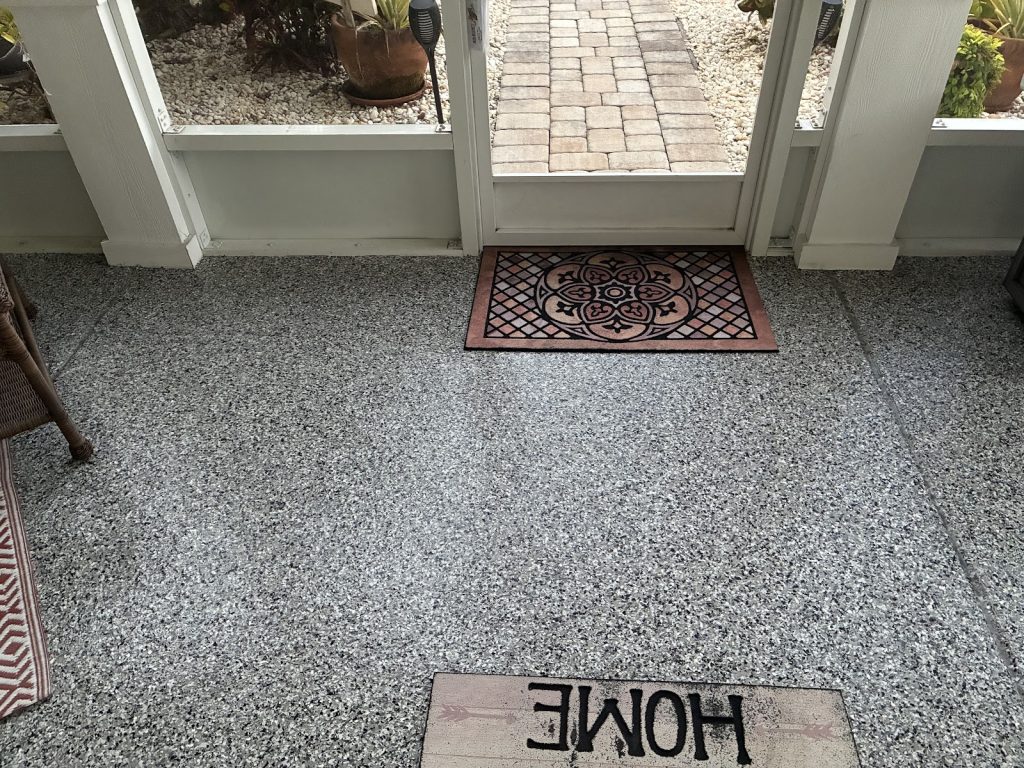
Yes, Florida heat and humidity affect epoxy flooring, but mostly during installation and cure rather than after the floor is finished. High humidity near the dew point can ruin adhesion and appearance, and a hot slab shortens working time and can cause bubbles. Once a properly installed system has fully cured, it handles Florida heat and humidity well for many years.
That is why two garages in the same Ruskin neighborhood can get very different results from similar products. The difference is almost always in how the installer read the conditions on the day of the job. Here is what actually happens, and what a good crew does about it.
How Humidity Affects Epoxy Flooring in Florida
The number that matters is not relative humidity by itself. It is the dew point, the temperature at which moisture in the air condenses on a surface. Florida summer dew points routinely sit in the 70s°F, which is high by national standards.
The 5-degree rule
The standard application rule is that the concrete surface must be at least 5°F (3°C) above the dew point during application and throughout the cure. If the slab is cooler than that, a microscopic film of moisture can form on the surface. You may not see it, but the coating does.
Coating over that film can cause:
- Weak adhesion that shows up later as peeling or lifting
- A cloudy, hazy or uneven finish
- Soft or slow-curing spots
- Poor bonding between coats in a multi-coat system
Where Florida garages get caught
Slab temperature often lags behind air temperature. On a humid early morning, or right after an afternoon thunderstorm cools things off, a garage slab can sit close to the dew point even when the air feels warm. A crew that measures slab temperature and dew point before mixing, and again during the job, avoids most humidity problems. A crew that just looks at the weather app does not.
How Heat Affects Epoxy Installation
Heat is the other half of the problem. Epoxy and polyaspartic coatings cure through a chemical reaction, and heat speeds that reaction up.
Shorter pot life and working time
High temperatures shorten pot life (how long mixed material stays usable in the bucket) and working time on the floor. In a hot Florida garage, material that would give a crew a comfortable window in cooler weather can start to thicken fast. When that happens you can get roller marks, uneven film thickness, flake that does not seat properly, and lap lines where fresh material meets material that has already started to set.
This is especially true of polyaspartic, which already cures quickly. Fast cure is one of polyaspartic’s biggest advantages, but in summer heat it demands an experienced crew mixing smaller batches and moving with a plan. We compare the two chemistries in detail in epoxy vs. polyaspartic flooring in Florida.
Direct sun and outgassing
Concrete is full of tiny pores holding air. When direct sun hits a slab, the concrete warms and that air expands and pushes up through the fresh coating. The result is outgassing: bubbles, pinholes and craters in the finish. In Florida this happens most at the front of a garage when the door is open to afternoon sun, or on lanais and pool decks.
Florida Conditions and How We Handle Them
| Condition | What it does to the coating | How a good installer handles it |
|---|---|---|
| Slab near dew point (early morning, after storms) | Moisture film, poor adhesion, hazy finish | Measure slab temp and dew point; coat only with a 5°F margin |
| Hot slab and hot garage | Short pot life, roller marks, lap lines | Smaller batches, planned layout, right crew size |
| Direct sun on the slab | Outgassing bubbles and pinholes | Shade the slab, adjust timing, keep doors managed |
| Afternoon thunderstorms | Temperature drop, humidity spike, wind-blown debris | Schedule around storm windows; keep the space closed during cure |
| Moisture vapor from the slab | Blisters and delamination over time | Test first; use a moisture-mitigating primer if needed |
Scheduling an Installation Around Florida Weather
You do not have to wait for winter to coat a garage in Florida. We install year-round across Tampa Bay and Sarasota. What changes in summer is the plan:
- Grind and repair first. We diamond grind the slab and repair cracks and pitting before any coating goes down. Grinding is not sensitive to humidity, so it can happen whenever needed.
- Time the coats. Coats go down in the window when slab temperature, dew point and sun exposure line up, which is often not the middle of a July afternoon.
- Keep the garage closed during cure. A closed door keeps out sun, rain, wind-blown debris and humid storm air while the coating cures.
- Choose chemistry for the season. Epoxy gives more working time in heat. Polyaspartic returns the floor to service faster but needs tighter control.
Most residential garages are done in 1–2 days depending on size, repairs and system. For walk-on and parking times, see how long a garage floor coating takes.
Does Heat Affect a Finished Epoxy Floor?
Once cured, a professionally installed system shrugs off normal Florida heat and humidity. A cured coating does not care that the garage hit 100°F in August. The heat-related problems that do show up on finished floors come from three places.
Hot tires
A car coming off summer asphalt brings hot tires into the garage. On thin or DIY coatings, those tires can soften the film and cause peeling and staining. A thick 100%-solids epoxy base with a polyaspartic topcoat on a ground slab resists it. The full explanation is in hot-tire pickup: why cheap garage coatings peel in Florida.
Sunlight
Standard epoxy is aromatic, which means it ambers, yellows and chalks under UV. In a garage with the door open much of the day, or on any outdoor surface, the topcoat should be a UV-stable aliphatic product such as polyaspartic. See UV protection for outdoor concrete in Florida.
Moisture from below
Florida humidity is not just in the air. Slab-on-grade homes over a high water table can push moisture vapor up through the concrete, and that pressure can blister and lift a coating even years later. That is a separate problem from air humidity, with its own testing and fixes, covered in moisture problems in Florida concrete.
Surface Prep Matters More in Humid Weather
A coating that goes down in marginal conditions has less room for error, so prep has to be right. Thin-film coatings typically need a concrete surface profile of CSP 2–3 on the scale from the International Concrete Repair Institute (ICRI), which diamond grinding produces consistently. Acid etching leaves residue, gives an uneven profile and does not remove old sealers, which leaves even less margin when conditions are marginal. We explain the difference in concrete surface preparation for epoxy: grinding vs. acid etching.
Signs a Coating Was Installed in the Wrong Conditions
If you already have a coated floor and are wondering whether heat or humidity caused a problem, these are the usual clues:
- Bubbles or pinholes concentrated near the garage door or sunny areas (outgassing)
- Cloudy or blotchy patches in an otherwise glossy finish
- Roller marks, lap lines or unevenly seated flake
- Peeling that starts within the first year, especially under tires
- Blisters that appear later, which usually point to moisture vapor from the slab
Most of these can be fixed by grinding off the failed coating and reinstalling under the right conditions.
The Bottom Line for Florida Homeowners
Florida heat and humidity are not reasons to skip an epoxy floor. They are reasons to hire an installer who measures conditions, grinds the slab properly and picks the right chemistry for the season and the space. Do that, and a residential floor can last 15–20+ years.
For the bigger picture on coatings in our climate, start with our complete guide to epoxy flooring in Florida. When you are ready to talk about your own floor, our garage floor coating team serves Ruskin, Apollo Beach, Sun City Center, Riverview and the rest of Tampa Bay, with free on-site estimates.
Frequently Asked Questions
Can you apply epoxy when it is humid outside?
Yes, as long as the concrete surface stays at least 5 degrees F above the dew point during application and cure. Installers should measure slab temperature and dew point rather than relying on the humidity reading alone.
What temperature is too hot to install epoxy?
There is no single cutoff, but high heat shortens pot life and working time, and direct sun on the slab can cause bubbles. Experienced crews adjust batch sizes and timing and keep sun off the slab.
Why does my epoxy floor have bubbles?
Bubbles and pinholes are often caused by outgassing, where air in the concrete expands as the slab warms and pushes up through the fresh coating. It is common when sun hits a slab during installation.
Will a Florida summer damage a finished epoxy garage floor?
Not a properly installed and cured system. The usual culprits on finished floors are hot tires on thin coatings, UV on an epoxy topcoat and moisture vapor from the slab.
Is it better to coat a garage floor in winter in Florida?
Cooler, drier months give more working time, but a professional crew can install year-round in Florida by timing coats around dew point, sun and afternoon storms.
Get a Free Estimate From One of a Kind Epoxy
One Of A Kind Epoxy Design And Painting has 15+ years of coating experience across Ruskin, Apollo Beach, Sun City Center, Riverview, Tampa, Parrish, Bradenton, Lakewood Ranch, Sarasota, Venice and North Port. Every floor starts with diamond grinding and crack and pit repair, then a coating system chosen for Florida heat, humidity and UV.
Call 941-281-8866 or request your free on-site estimate. We’ll measure your space, check the slab, and recommend the right system for how you use it.