
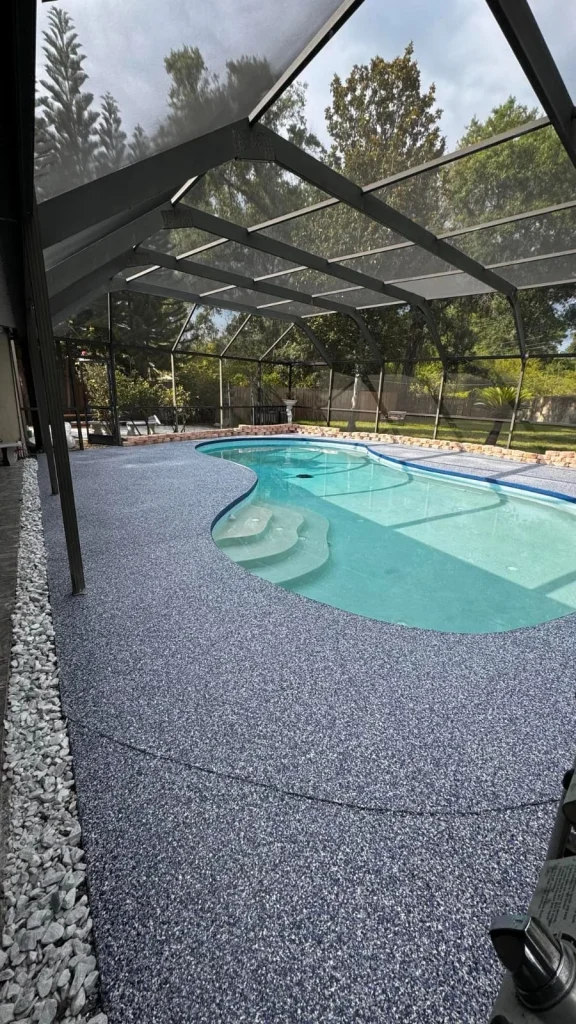
The best slip-resistant pool deck coating for a Florida home is a UV-stable system, typically finished with polyaspartic, that has grip built into the topcoat through broadcast aggregate or a flake texture, in a light color that stays cooler underfoot. The goal is enough texture to be safe for wet, bare feet without making the deck hard to clean. Getting that balance right matters more than the brand of coating.
Pool decks and lanais are some of the hardest-working surfaces on a Florida property. They get sun all day, water constantly, bare feet, pool chemicals and afternoon storms. Here is how slip-resistant coatings work, what your texture and color options are, and what to ask before you commit.
What Makes a Pool Deck Coating Slip-Resistant?
A smooth, glossy coating is slick when wet, the same way a polished tile floor is. Slip resistance comes from texture in the top layer of the system. There are two main ways to get it.
Broadcast aggregate in the topcoat
Fine particles are mixed into or broadcast onto the topcoat to create a gritty surface. Common options include:
- Aluminum oxide: very hard and durable, provides aggressive grip
- Polymer grit: softer and gentler on bare feet, easier to clean
- Silica: an economical option for adding texture
The amount of aggregate and its particle size control how rough the finish feels.
Flake broadcast
A full broadcast of decorative vinyl flake into the base coat creates a naturally textured surface once sealed. Flake floors have texture on their own, and anti-slip additive can be added to the topcoat for extra grip where needed. Flake also hides water spots, leaves and pool residue between cleanings, which is why it is popular for lanais.
Balancing Grip and Cleanability
More texture is safer, but it is also harder to clean. Very aggressive grit holds dirt, sunscreen and mildew in the grooves and can be rough on bare feet and knees. Too little texture leaves a surface that is easy to hose off but slick in the wet zones.
| Texture level | Typical approach | Grip when wet | Cleaning | Best for |
|---|---|---|---|---|
| Light | Flake with smooth clear topcoat | Moderate | Easiest | Covered lanais that rarely get wet |
| Medium | Flake plus fine polymer grit in topcoat | Good | Easy with a soft brush | Most pool decks and screened lanais |
| Heavy | More or coarser aggregate such as aluminum oxide | Highest | Harder; holds dirt | Steps, pool entries, slopes, commercial pools |
A common approach is to vary the texture across a single deck: more grip at pool steps, entries and sloped areas, and a lighter texture in the lounging and dining areas where people want an easy-to-clean surface.
Why UV Stability Is Non-Negotiable Outside
A pool deck or unscreened lanai gets hours of direct Florida sun. Standard epoxy is aromatic, so it ambers and chalks under UV, and the slip-resistant topcoat would degrade right along with it. Outdoor systems should be finished with an aliphatic, UV-stable topcoat such as polyaspartic. Epoxy can still be part of the system as a base coat, but it should not be the layer the sun hits. We explain the chemistry in can epoxy be used outdoors in Florida?
Cool-to-Touch Colors
Anyone who has walked barefoot across a dark deck in July knows how hot concrete can get. Color choice is one of the easiest ways to keep a coated deck comfortable:
- Light neutrals such as light gray, tan and sand reflect more sunlight and stay cooler.
- Light flake blends keep the surface cooler while hiding dirt and water spots.
- Dark solids and dark flake absorb heat and are best kept to covered areas.
Lighter colors also show less fading over time and hide the white residue that pool water and chemicals can leave behind.
Prep and Condition of the Existing Deck
Many Florida pool decks already have something on them: a spray texture, old paint, a sealer or an earlier coating. Before a new system goes down, loose or failing material needs to come off and the concrete underneath needs a clean, open surface. We diamond grind to open the slab and repair cracks and pitting before coating. For why grinding beats acid etching, see proper concrete surface preparation for epoxy.
Pool decks and lanais sit on grade, often without a vapor barrier and surrounded by irrigated landscaping and splash-out. Moisture vapor rising through the slab can blister a coating, so testing matters here as much as anywhere. That topic is covered in moisture problems in Florida concrete.
Pool Chemicals and Everyday Care
A sealed coating makes a pool deck far easier to keep clean than bare, porous concrete. A few habits help it last:
- Rinse the deck regularly to remove chlorine residue, salt and sunscreen
- Clean up spilled pool chemicals promptly rather than letting them sit
- Use a soft-to-medium brush on textured areas to lift dirt from the grit
- Use furniture glides or pads to protect the topcoat
- Recoat the topcoat when texture or gloss wears down in high-traffic spots
For more on what coatings can and cannot handle, see chemical and stain resistance: what floor coatings can handle.
Common Pool Deck Coating Mistakes
Most pool deck complaints we see come from a handful of avoidable choices:
- High-gloss finishes with no added texture. They look great dry and turn slick the moment someone climbs out of the pool.
- Epoxy left as the exposed topcoat. It yellows and chalks in Florida sun, and the surface degrades along with its grip.
- Dark colors in full sun. They get uncomfortably hot for bare feet.
- Coating over loose paint or old texture. The new system is only as well bonded as whatever is underneath it.
- One texture everywhere. Steps and entries usually need more grip than lounge areas.
Questions to Ask Before You Choose a System
- What topcoat will the sun hit, and is it UV-stable?
- What aggregate or flake is providing slip resistance, and how will it feel barefoot?
- Will texture be heavier at steps, entries and slopes?
- How will the existing surface be removed and the concrete prepared?
- Will the slab be checked for moisture before coating?
- What cleaning routine keeps the texture working?
Clear answers to those questions tell you more about how the deck will perform than any product name.
Commercial and Community Pools
For condo associations, clubhouses, hotels and other commercial pool areas, slip resistance is also a workplace safety issue. OSHA 1910.22 requires walking-working surfaces to be kept clean and, as far as possible, dry. A textured, easy-to-clean coating supports that, and heavier texture at entries, steps and around showers is common in commercial settings. Commercial pool decks see more traffic and are typically resealed periodically.
What a Pool Deck or Lanai Coating Costs
Sarasota-market 2026 contractor pricing puts lanai and pool deck coatings at roughly $6.50–$7.75 per square foot as a typical range. The final price depends on deck size, the condition of what is already there, how much crack repair is needed, whether moisture mitigation is required and the texture and finish you choose. A site visit is the only way to get a real number.
Where We Install Pool Deck and Lanai Coatings
Screened lanais and pool cages are everywhere in Sarasota, Lakewood Ranch, Venice and North Port, and pool decks are common from Bradenton and Parrish up through Ruskin, Apollo Beach and Tampa. We serve Hillsborough, Manatee and Sarasota counties with free on-site estimates. Learn more on our concrete polishing and pool deck coatings page, or read our complete guide to epoxy flooring in Florida for the bigger picture.
Frequently Asked Questions
What is the most slip-resistant coating for a pool deck?
A UV-stable system with aggregate such as aluminum oxide or polymer grit in the topcoat provides the most grip. Heavier texture is best at steps and entries, with lighter texture in lounging areas for easier cleaning.
Is epoxy slippery around a pool?
A smooth, glossy coating can be slippery when wet. Adding anti-slip aggregate to the topcoat or using a flake system creates texture that improves grip for bare feet.
What color pool deck coating stays coolest?
Light neutral colors such as light gray, tan and sand, or light flake blends, reflect more sunlight and stay cooler underfoot than dark colors.
Can you coat over an existing pool deck?
Often yes, but loose or failing coatings, paint and texture need to be removed and the concrete diamond ground and repaired first. Moisture should also be checked since pool decks sit on grade.
How much does it cost to coat a lanai in Sarasota?
Sarasota-area contractor pricing in 2026 runs roughly $6.50 to $7.75 per square foot as a typical range. Your final price depends on size, existing surface condition, repairs and finish.
Get a Free Estimate From One of a Kind Epoxy
One Of A Kind Epoxy Design And Painting has 15+ years of coating experience across Ruskin, Apollo Beach, Sun City Center, Riverview, Tampa, Parrish, Bradenton, Lakewood Ranch, Sarasota, Venice and North Port. Every floor starts with diamond grinding and crack and pit repair, then a coating system chosen for Florida heat, humidity and UV.
Call 941-281-8866 or request your free on-site estimate. We’ll measure your space, check the slab, and recommend the right system for how you use it.